Monday, October 18, 2010

Case Study 1: Scream

Micro features
Firstly the production titles go on the screen before the film starts. The opening begins with a scary title font; it begins with a white font then changes to red then fades away. Red is a symbolic colour for blood and death. The first scene features a close up of the girl's (monster fodder) hand picking up the phone, this is a dramatisation of an everyday event to make it seem scarier. The person on the other end of the phone claims he has the wrong number, yet when he phones back it hints he is a stalker. When she picks up the phone again, there is a slight dutch angle to show all is not what it seems and the camera is hand held, showing the instablility in the character and making the scene more realistic.


The establishing shot first shows a trees branches, which are dark except for the green leaves; green being a very ghostly colour in horror, because of the light on the leaves it makes the branches look like a crooked, evil hand.
The establishing shot goes onto showing the house being very isolated, this is exaggerated by the darkness and the swing on the tree swaying in the wind. The popcorn bag heating on the cooker represents the tension as it begins to expand, we are constantly reminded of this by the constant close ups of the popcorn bag. The conversation between the killer and monster fodder acts as a hook to the audience as he begins to reveal his purpose in talking to her; to kill her. When this is revealed, the camera remains hand-held and the rooms appear darker. There is also constant reaction shots of her crying. The music throughout the sequence remains parallel as the tension builds.

Macro Features
As the sequence starts, the genre is introduced through the titles; the font being stretched and turned red symbolises blood and torture. There is also a non-diagetic scream to represent the genre. All of this is iconography of the horror genre, further iconography is featured throughout the film; including the mask, the knife and the isolated location. The costume and the line "Do you like scary movies?" has also become apart of the franchise.

Wednesday, October 13, 2010

Sub-Genres of Horror

Teen horror - This is a sub-genre formulated at attracting a teenage audience. It involves teenage cast and is set in places similar to a stereotypical adolescent like a house or a shopping centre. This sub-genre works well as a hybrid with a slasher represented in Scream.

Psychological - Often in these films the antagonist can be disguised as a completely normal person, and the antogonists identity may not be founded out. However in other films, like Hannibal, the antagonist is already realised, yet this could be because this is a franchise. These psychopath antagonists may menace and disturb the protagonist through psychological threats. Then they may end in an explosion of violence.

Slasher/Gore - This sub-genre works centrally around the sharp apporaters used by the antagonist and blood from their victims. These films can involve a lot of disturbing torture like SAW or just an antagonist with who uses a specific weapon like a knife, portrayed in Scream.

Monday, October 11, 2010

Characteristics of the Horror Genre

Iconography
The iconography of horror are features which are typical to horror movie scenerio. In films such as Scream they use masks and knives as iconography to the antagonist. They use a remote location and darkness to evoke the sense of isolation. They also use womens screams as a sign of helplessness; all these features are horror iconography.

Rules
In horror movies, specific things of goverened by rigid rules; for example werewolves can only be killed by silver bullets and vampires can only be killed by a stake through the heart. These rigid rules are key to some storylines and give an idea to the climax to the film.

Settings
Setting is one of the key aspects used to define whether the movie is a horror or what kind of sub-genre the horror could be. Irrational, supernatural worlds can seperate the horror genre from other genres, for example in films like Nightmare On Elm Street when it goes into the 'nightmare' world it is very dark, mechanical and uses a lot of the colour red to represent blood and death. Even in teen horrors such as Scream, there is a gothic and horrific presence, this is done through things such as isolated settings and darkness.

Twists
There are occasionally twists throughout some horror movies, these are done to change the audiences typical perceptions about how the film will end. In some films the audience is encouraged to feel sympathy for the antagonist, this is done in films such as Frankenstein. In the Sixth Sense there is a major twist here Bruce Willis is actually dead and that is why the protagonist can see him.

Archetypes
Archetypes are an original model or a ideal example of a person; a prototype upon which others are copied. Most of the characters found in horror movies are archetypes.

Conventions
Conventions are aspects which are traditional to the horror genre; similar to iconography. Certain conventions go under different sub-genres, yet some sub-genres can share them. For example an isolated setting or an indestructable monster.

Final Girl Theory
This type of character is, essentially, a female protagonist with noteable masculine characteristics. The 'final girl' almost always shows a higher intellegence of the antagonist whilst others appear naive and more vulnerable. Carol. J. Clover, the theorist behind 'Final Girl', states that this character is typically sexually unavailable or virginal, is more rational and avoids situations, such as narcotic use, as they effectively lead to the demise of each victim via the antagonist. These characters are often branded with a unisex name, such as Sidney (Scream), which immediately takes them away from the stereotypical 'monster fodder' type girl who is; sexually objectified, relatively unintelligent and constantly screaming/ in fear. The film Saw II adds an element to this theory as the antagonist has a previous experience with the 'final girl' leaving them to join together in the end. Though Carol J. Clover acknowledges this, it is rare.
Clover also states, in her book Men Women and Chan Saws: Gender in the Modern Horror Film, that the 'final girl is often made masculine via a phallic appropriation in the final antagonist-final girl confrontation. A weapon is usually the tool the character picks up, identifying herself as masculine with this phallic object. This can be seen in films such as Alien vs Predator, in which the final girl takes a spear (phallic object) and thrusts it through the chest (representitive of heart, love, emotions and sexuality) of the antagonist.
Sexuality is the basis on which the final girl theory is formed. It states that there is a crisis in the identification of the sexuality of both final girl and the antagonist, which is settled in a final battle situation. The final girl is rarely introduced in the opening scene, with a monster fodder/ stock character being the likely replacement, as in scream;


Wednesday, September 29, 2010

Our chosen genre

The genre of our sequence is horror; it is a genre easily identified and portrayed. It's iconographies are vast including aspects such as darkness and isolation. This genre also allows us to experiment with a variety of different costumes, props, editing techniques, sound and camera angles

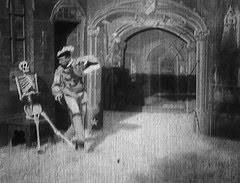
Horror films are films which are unsettling to the viewer linking closely to other genres such as fantasy, science-fiction and thriller. The genre is made to expose a viewers worse fears and nightmares creating a 'thrill' for those watching. The horror genre in film began with short movies made by filmmakers such as Georges Méliès in the late 1890s; films such as the silent three minute long Le Manoir du diable (The House of the Devil) from 1896. Some consider Le Manoir du diable the first ever horror film.

As horror progressed into the 1920s Hollywood began to make their own horror movies; classics like Dr Jekyll and Mr Hyde (1920), The Hunchback of Notre Dame (1923) and The Lost World (1925). Horror was continued using these 'monster' characters till the Vietnam war in the 1960s. Horror movies changed and expressed more gore and evolved into what it is today; such movies like The Exorcist (1973) and The Texas Chainsaw Massacre (1974) changed the image of horror after Vietnam as filmmakers pursued the imagery saw in that war.

Choosing horror as our genre allows us a variety of options to choose for our movie. Many sub-genres may be linking from horror including gore and psychological. Horror is a genre which is very recgonisable to modern day viewers therefore making it easier to depict.

Effective film opening: Example 3 Transporter


Micro Features

Camera & Editing - The first shot is from a security camera view at a high angle, the shot is in night vision and the titles overlapping the opening scene is also in a night vision green font. The scene begins with a wide, establishing long shot of a car park. Slow panning is used around the car park leading up to a slow medium shot of a black car. Close-up shot is used to view the car panning from the back, to the side, to the drivers seat at an eye-line match so it looks as though the audience is sitting in the passenger seat. The pace of the continuity cuts begin to speed at the part where the driver begins to get ready to set off in his car. Close-ups of his gloves, watch and hands setting up his car and turning the radio on gives the feel of a visual instruction and beginning ritual of what he must do before he drives. Close up of the driver in the car park when he starts his car reveals to the audience what the driver (main character) looks like. Tracking and panning used as the car is driving along the city, movement of the camera is smooth and match-on-action cuts are also used. Over-the-shoulder-shot is used when the driver is at a stop at the traffic lights, over the shoulder view shows two policemen watching the driver. When the driver has pulled up outside a large building, the camera views a low angle looking up towards the clock on top of the building. Then the angle of the shot changes fast and dramatically and views at a high crane angle looking down at the robbers running out of the building doors. This gives a strong contrast and quick change of action that has suddenly happened.

Sound - Non-diagetic and diagetic sounds are used in this opening scene. Slow intense music is played in the beginning at the car park, Also camera/tv static malfunctioning noices are played over as the titles appear over the scene. The music grows slightly louder and the pace gets a little quicker as the camera moves towards the car, this is to build suspense into revealing who is in the car. Music stops suddenly as the title of the movie appears over the camera finally reaching the driver. The driver then turns on his radio playing classical music but then non-diagetic music plays when he starts driving. The music the audience hears at this point changes from classical to action type music. The dynamics of the music varies, it goes loud then quiet but the beat of the drums keeps the music sounding intense - this music may be used to play on the audiences emotions. The music is not parallel to the action, when the robbers come charging out of the bank with guns and money, the music stays calm and at a normal pace. The music may not be parallel to action but it may reflect upon how the main character feels and gives the audience an idea of the main character's attitude.

Lighting - Begins with night vision lighting then flashes to the actually lighting in the scene. The main key-lighting looks as though it is coming from the car park lights. In some areas of the car park, it is brightly lit and in others there is strong shadow. The car is black therefore it is very visable to see the car park lights reflecting off of it, this gives the car a more slick appeal to it. The driver's identity is hidden by dark shadows, only his face is lit slightly, this gives the character a sense of mystery.

Mise en Scene - Night vision from a security camera view represents survalliance which is in relation with the law, this shows that what is going to happen in the scene may or may not be illegal in the film. The leather gloves indicates that the main character does not want to leave fingerprints anywhere he touches. The main character is dressed in a smart suit. black and white. This may show that the character is presentable, smart, masculine and shows that he may be of a profession. A large bank which is filled with money could end up being robbed. The car with many gadgets such as the changing of liscence plate has a 'James Bond' appeal to it.

Macro Features


Iconography - Guns, the weapons iconographies the genre of action. The main character casted in the shadow in the car gives the character an identity of being mysterious. The location and city is usually where an action film takes place as the everyday things such as parked cars, people, police, city roads etc are seen or used as obsticles which trap someone from getting away. The use of intense music also rienforces the genre of action.

Effective film opening: Example 2 Kick Ass

Micro Features

Camera & Editing - Titles are used firstly in the opening scene across a first person view shot flying through the sky. A high crane, establishing shot is used to show the location of the opening scene. Slow panning and tracking is used to follow what is happening in the scene. Matched cuts are used to keep the flow of the shots seem smooth. High angle shots are used from the lower crowd of people looking above at the superhero, this angle is used to represent that the superhero on top of the building seem to have a superior higher power than the people in the city streets. Slow zooms are used on the superhero to create a dramatic effect of the characters introduction. Close-ups are used on the super-hero in the opening scene to introduce him. When the scene location changes from the city to a high school, the shots changes to hand-held but still quite steady. Over shoulder shots and medium shots are used with the hand-held. This is used to make the audience feel more involved in the scene as it tracks and follows the main character as he enters the school. Camera pans onto the film title, gives the title introduction a comical effect like it swipes slowly onto the screen.

Sound - Non-diagetic sound is used to begin with as the titles appear on the screen. The music begins slow and calm, it sounds adventurious and hero like, a slow kind of fanfare to build up excitement to the characters introduction. Voice over narrative talking about old traditional superheroes play over the music, the voice sounds like a speech through an old microphone - gives an old fashioned feeling. The voice over narrative then changes to a teenage voice, the main character. Diagetic sound is used when the characters and locationm is established. The background music's pace is parallel to the action of the superhero, it grows louder and faster as he falls from the building. The music cuts off instantly when the superhero dies, this is done to create a sudden dramatic end to the superhero's life. When the location changes from city to high school, the non-diagetic music is playful, exciting music - It is a band music to represent high school.

Lighting - It appears to be natural lighting from the sun that shines down on the superhero and the other characters in the opening scene. The lighting is from high above, this gives the lighting a spotlight appeal to it. The bright light shines down on the people on the streets and it looks as though the source of light comes from the superhero on top of the building. When the location changes, the lighting is still bright. The light shines on the main character, this same use of lighting could show a relationship between the two characters, the teenage male main character and the superhero.

Mise en Scene - The clouds indicate that the camera view is in the sky flying. A large city landscape is usually where a superhero is based deep within, this shows the tradittional setting for a superhero comic. Also the everyday career oriented people in the city comes across something different to their routined lifestyle is usually the basic plot for a superhero film. The superhero costume signifies that this film is about superheroes and the genre would be action as there would be many action in a superhero film. The main character wears big glasses, the glasses on the character gives the appeal that he is intelligent or shows the stereotype of him being a 'geek.'

Macro Features


Iconography - In one shot, the camera pans onto the license plate of the taxi with the title 'Kick-Ass,' the tail lights on the car are in shape of wings. This makes the title look almost like a superhero logo or symbol as many other traditional superheroes have an iconic symbol or logo e.g. Batman's logo is in the shape of a bat. This also rienforces the genre of superhero/action.

Effective film opening: Example 1 Blood Diamond

Micro Features


Camera & Editing - Begins with titles and facts fading slowly in and out in front of a map outline of Africa, this establishes where the location of the film is shot. Also it provides some facts that gives the audience a clue to what the plot is to the film. Extreme close-ups are used in some shots, e.g. when the main character is fishing on his boat, this shot is used to show the importance of what he is doing, it draws the audience attention to really focus and figure what exactly he is doing. Medium shots when the characters are indoors in their home, this shows the audience how little space they have to live in. Many location/establishing shots are used in the beginning to establish the location and show the scenery, displays that the country is exotic and hot. Fast zooms are used when the action begins, the camera zooms fast into the killing of the innocent villagers. Fast pace cuts when the action occurs, this creates a dramatic and thrilling feeling.

Sound - Non-diagetic and diagetic sound is used throughout this opening scene. Music plays over the titles in the beginning, the music with the drums grow louder and faster as it gets to the end of the titles then cuts off when the scene begins - this gives the beginning of the scene a dramatic opening. The characters narratives varies from English to African with subtitles. This symbolise that there is a theme of contrast between English and African or Ethnicity throughout the film. The non-diagetic sounds are parallel to the action that occurs in the opening scene.

Lighting - The lighting used in this opening scene seem all come from a natural source, e.g. the lamp. A lamp is lit in the beginning shot and in the other shots the only source of light comes from the sun.


Mise en Scene - The props used symbolise many things in this opening scene. The lamp, tells us that the country or area which the characters live in is poor as they do not have access to electricity. Poor housing, the families houses are made from branches - all natural materials not man-made. This shows the audience that again, the area is poor or that the country is in poverty. The clothing also tells the audience about the poverty in which they live in as they can not afford better quality clothes. The main character is seen with his shirt unbuttoned, this may symbolise masculinity as the main male character is muscular and shows bare skin. He saves his family first before himself which shows heroism, he may be the hero in this film. The location of the film is exotic, calm and peaceful. But the sun shines bright and intense, this could symbolise that the peacefully scenery can be broken with intense conflict.

Macro Features

Iconography - Guns and weapons are used in this scene, this iconographies that this film maybe in the genre of action. Conflict between innocent villagers and 'rebels' iconographies that this film may also be in the genre of drama.